 Albert Eugene de Forest (June 22, 1849 – October 8, 1917), born Mary J. Bradley, was a prominent drama and elocution teacher who taught and performed across the San
Francisco Bay Area and Los Angeles for over three decades.
Albert Eugene de Forest (June 22, 1849 – October 8, 1917), born Mary J. Bradley, was a prominent drama and elocution teacher who taught and performed across the San
Francisco Bay Area and Los Angeles for over three decades.Husband John Milton Hart, Partner Alida Cornelia Avery, Wife Margaret Barton Hawley
Queer Places:
Vassar College (Seven Sisters), 124 Raymond Ave, Poughkeepsie, NY 12604
210 Turk St, San Francisco, CA 94102, USA
216 Turk St, San Francisco, CA 94102, USA
Cypress Lawn Memorial Park, 1370 El Camino Real, Colma, California 94014 United States
Albert Eugene de Forest (June 22, 1849 – October 8, 1917), born Mary J. Bradley, was a prominent drama and elocution teacher who taught and performed across the San
Francisco Bay Area and Los Angeles for over three decades.
Born on June 22, 1849, in Newtown, Connecticut, he was the only surviving child of Walter and Julia Bradley, who named him Mary J. Bradley at birth. From a very early age, De Forest identified as a boy. He chafed at his parents’ insistence that he dress and behave like a girl, describing his childhood self as a tomboy. De Forest later reflected that his "male soul" was tied to his mother's profound grief following the death of a five-year-old son the year before De Forest's birth—likely Albert Bradley, who died in 1848 and is buried at Botsford Cemetery in Newtown.
After his attempts to enroll in a men's college were thwarted, De Forest enrolled as Mary J. Bradley at Vassar College in Poughkeepsie, New York, in 1867.
It was at Vassar that he formed a life-changing bond with Dr. Alida Cornelia Avery, the college's resident physician and a prominent suffragist. Dr. Avery was a vocal opponent of corsets and restrictive women's clothing, actively encouraging students to adopt practical, comfortable attire. She offered a sympathetic ear to De Forest's personal struggles and became a lifelong mentor, friend, and mother figure to him.
While pursuing an acting career on the East Coast, De Forest (still using the name Mary Bradley) met Rev. John Milton Hart, a newspaperman and graduate of New York's progressive Union Theological Seminary. They were married on September 7, 1877, in Newtown, Connecticut—a union De Forest later characterized as a purely platonic arrangement.
By 1880, the couple relocated to San Francisco, where census records list J. M. Hart and Mary Hart residing at 210 Turk Street, while Mary J. Bradley (listed as a teacher of elocution) lived nearby at 216 Turk Street alongside her mother, Julia Bradley, and cousin, Ella Bradley. They eventually settled in San Jose, where Dr. Avery had opened a medical practice in 1887. During this period, De Forest taught and performed oratory and dramatic arts throughout the Bay Area under the names Mrs. Mary J. Bradley and the stage name Eugenie De Forest (sometimes spelled De Forrest).
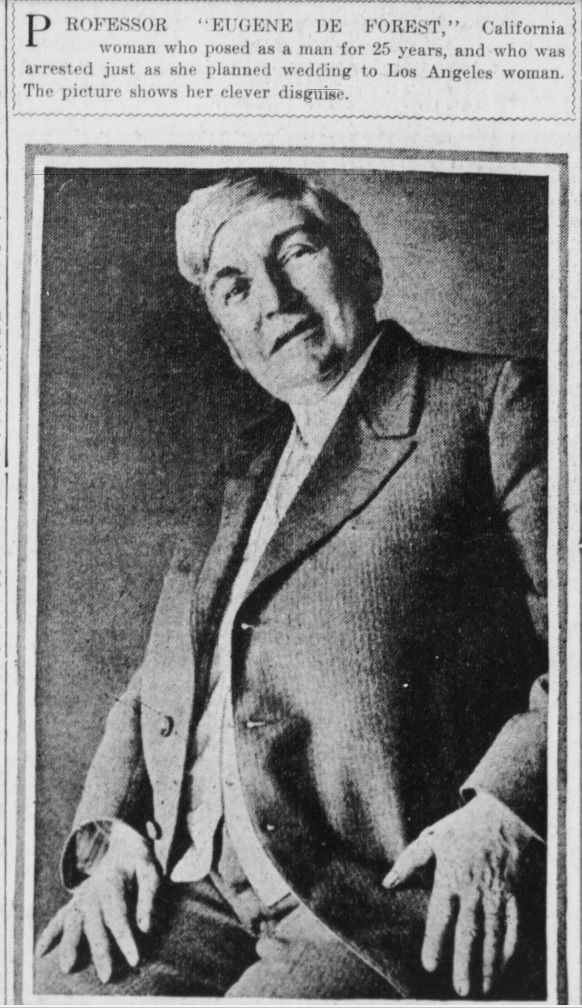
Following John Hart's death in 1893, De Forest began living openly as a man. On September 1, 1893, he made headlines across the region by stepping out through downtown San Jose in full men's fashion. As reported by the San Jose Daily Mercury on September 2:
"A stylish dark brown double-breasted sack coat, trousers of the latest pattern with a mauve-colored Derby of the latest style, with a very broad brim, which the girls term 'a hat with a sidewalk around it.' A new pair of patent-leather tipped lace shoes covered her feet and in her hand was a small ebony cane."
De Forest explained to reporters that he had felt male since early childhood and would no longer tolerate wearing skirts. He revealed that his late husband was fully aware of his identity and, from his deathbed, had encouraged him to be true to himself, adding: "My life is an open book ... I am not ashamed of anything I have done."
In 1895, he formally announced his name change to Albert Eugene de Forest. Throughout this period, he remained close to Dr. Avery and her extensive network of suffragists and temperance advocates. Bay Area newspapers generally covered De Forest with curiosity and respect—though still utilizing female pronouns, press coverage treated his life as a fascinating novelty, likely reflecting both his recognized upper-class background and the Bay Area's relatively open artistic climate in the 1890s.
Dr. Avery’s death in 1908 was a significant loss for De Forest. Seeking a fresh start where his past was unknown, he relocated to Southern California. In 1911, he married Margaret Barton Hawley in Santa Barbara, though the marriage ended in divorce shortly after.
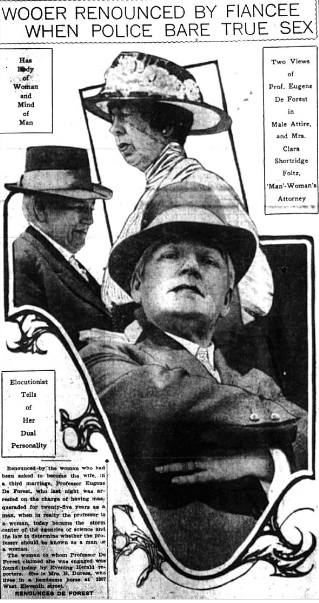
In 1915, while preparing to marry a widow named Mrs. Durress in Los Angeles, someone outed De Forest to local authorities, leading to his arrest under municipal cross-dressing ordinances. Pioneering suffragist attorney Clara Shortridge Foltz stepped in to represent him, and the legal charges were ultimately dropped. However, alarmed by the sensational media coverage, Mrs. Durress broke off the engagement.
Unlike the gentle press coverage of the 1890s, the 1915 newspapers took a hostile, sensationalist tone. De Forest pushed back directly in an eloquent letter published in the Los Angeles Evening Herald on September 1, 1915, explaining that he had simply been born in a woman's body with the soul of a man.
De Forest remained in Los Angeles and continued his work as a drama teacher until he contracted pneumonia. He passed away on October 8, 1917. While hospitalized during his final illness, he successfully advocated to be placed in the men's ward.
On his death certificate, his name was recorded as "Albert Eugene De Forest," with his sex listed ambiguously as "Female?". His remains were cremated at Evergreen Cemetery in Los Angeles and shipped to Cypress Lawn Cemetery in Colma, San Mateo County, California, where his ashes were inurned alongside his lifelong mentor and friend, Dr. Alida Cornelia Avery, in the Old Columbarium.
References:
 Public Faces, Secret Lives by Wendy L. Rouse |
 True Sex: The Lives of Trans Men at the Turn of the Twentieth Century by Emily Skidmore |
Other references:
Support this project
This website is a passion project researched, developed, and funded entirely by me. If you find the content valuable and would like to help support the ongoing research and hosting costs, any contribution is deeply appreciated.
Thank you for keeping this independent resource alive!
My books on Amazon: Elisa Rolle's books